 Back to Guides
Roof Decking Explained: Why What's Underneath Your Shingles Matters


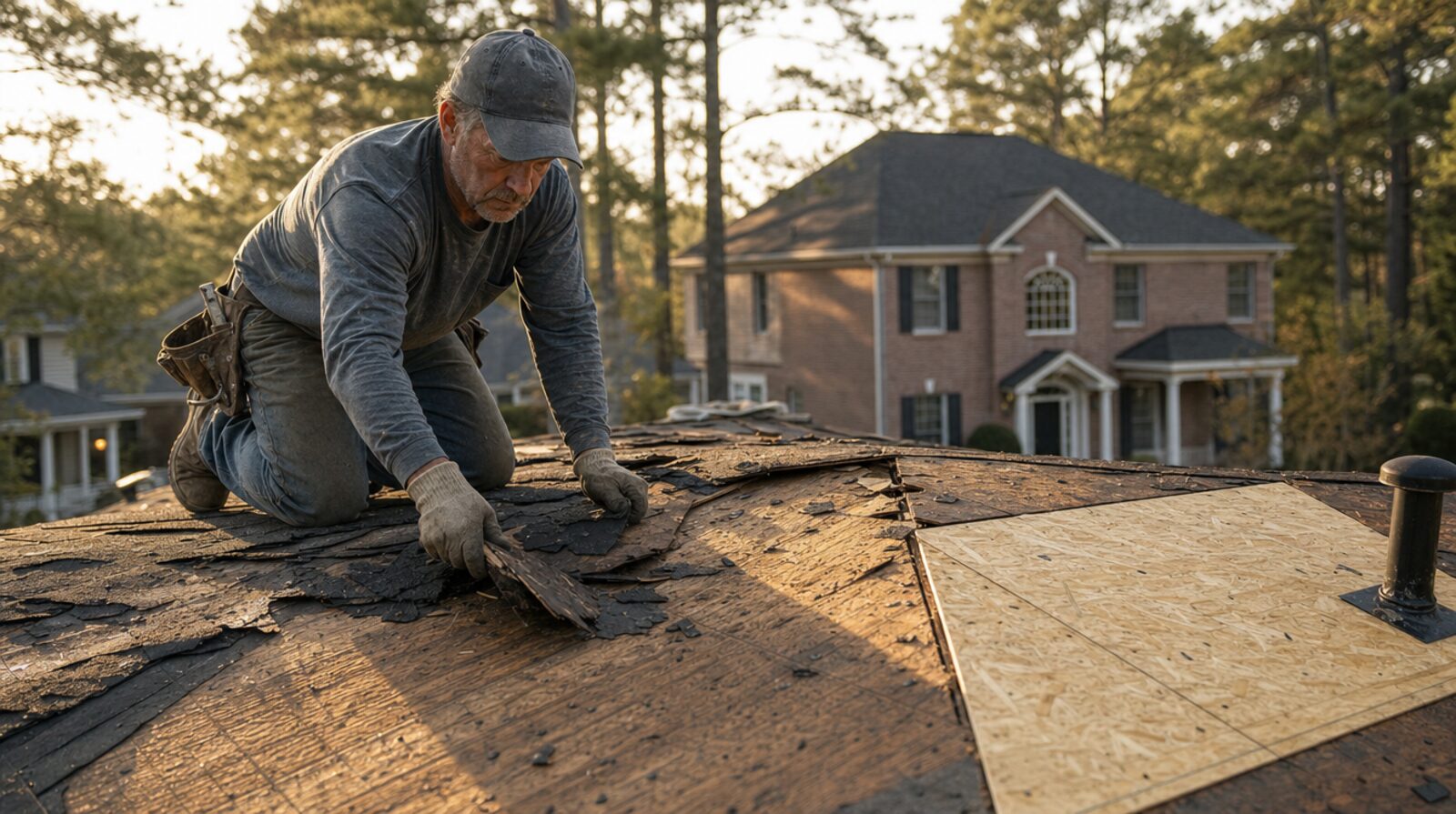
Most homeowners can tell you what shingle color is on their roof. Almost none can tell you what's underneath it. That's understandable — decking is the part of a roof system nobody sees unless something has already gone wrong. But after climbing more roofs than we can count across Greensboro, High Point, and Winston-Salem, we can tell you this: the decking is doing more work than the shingles are. Shingles shed water. Decking is what everything else is nailed to, and it's what keeps your roof from sagging, soaking, or failing early.
What Roof Decking Actually Is
Decking (also called sheathing) is the structural layer fastened directly to your roof trusses or rafters. Everything else — underlayment, drip edge, shingles — sits on top of it. In the Triad, you'll mostly find two materials on homes built from the 1990s forward:
- OSB (oriented strand board): Made of compressed wood strands bonded with resin. It's the most common decking material in newer construction because it's cost-effective and comes in consistent, uniform sheets.
- Plywood: Made of thin wood veneers glued in cross-grain layers. It's a bit more expensive but tends to hold its shape a little better when it gets wet, since it dries out faster than OSB.
Older homes in established neighborhoods around Fisher Park, Irving Park, or Old Salem sometimes still have solid plank decking — actual 1x6 or 1x8 boards nailed side by side. It's sturdy, but it doesn't behave the same way modern sheet decking does, and it changes what your roofer needs to plan for during a tear-off.
Why Decking Condition Determines the Life of Your New Roof
You can put a brand-new roofing system on top of compromised decking, and it will fail faster than it should. We see this constantly on re-roofs. The shingles look fine from the driveway, but once we pull them off, the deck tells a different story:
- Soft or spongy spots underfoot usually mean moisture has been getting into the wood for a while, often from a slow leak around a vent pipe, chimney, or valley that went unnoticed for years.
- Delamination — OSB layers separating or plywood veneers peeling — happens when the material has taken on water repeatedly, whether from a leak or from inadequate attic ventilation pushing moisture up from below.
- Sagging between rafters often points to decking that's too thin for the rafter spacing, or wood that's lost structural integrity over time.
- Nail pops and fastener rot show up as small bumps under the shingles — a sign the deck itself is no longer holding fasteners securely.
None of these are cosmetic issues. A shingle nailed into rotten or delaminated decking doesn't hold the way it should in a wind event, which means the very system meant to protect your home starts working loose from the inside.
What Drives Decking Damage in This Climate
The Piedmont Triad's mix of humid summers, ice-and-thaw winters, and pop-up thunderstorms is tough on decking specifically:
- Attics that run hot and poorly ventilated in July and August trap moisture against the underside of the deck.
- Ice damming along eaves in a cold snap can force water backward under shingles and directly into the wood.
- Old or improperly lapped underlayment lets wind-driven rain reach the deck during our spring and summer storm systems.
What We Look For — And What You Should Ask About
When we tear off an old roof, decking inspection isn't an afterthought — it happens board by board, sheet by sheet, before a single new shingle goes down. A few things worth knowing as a homeowner:
- Replacement is priced by the sheet, not the whole roof. A reputable contractor should show you exactly how many sheets of decking were replaced and why, not just add a vague "decking fee" to the invoice.
- Matching thickness matters. Most Triad homes use 7/16" or 1/2" OSB or plywood. Mixing a thinner patch into older 5/8" decking can create an uneven nailing surface that telegraphs through the shingles over time.
- Fastener pattern matters as much as the material. Proper nailing pattern and spacing on new decking sheets is part of what keeps a roof performing in high wind — it's not just about slapping the sheet down.
- Ventilation gets addressed at the same time. If we're replacing decking because of moisture damage, we're also looking at your soffit and ridge ventilation, because replacing the wood without fixing the airflow problem just restarts the clock.
If you're getting quotes for a re-roof, ask each contractor how they handle decking they didn't expect to find soft. A vague answer, or a flat "we won't need to replace any," before they've even opened up the roof, is worth a second opinion. Decking condition can't be reliably judged from the ground or from photos — it has to be checked once the old roofing material comes off.
A roof is only as good as what it's nailed to. Shingles are the finish work. Decking is the foundation.
If your roof is getting close to replacement age, or if you've noticed a soft spot when you (carefully) walk your attic joists, it's worth having someone knowledgeable take a look before small deck damage turns into a larger structural repair.
Stop Guessing on Price
Get precise measurements and a detailed price range for your specific roof right now using our AI technology. No home visit required.
Get my price