 Back to Guides
Ridge Vents vs. Box Vents: Which Attic Ventilation Wins?


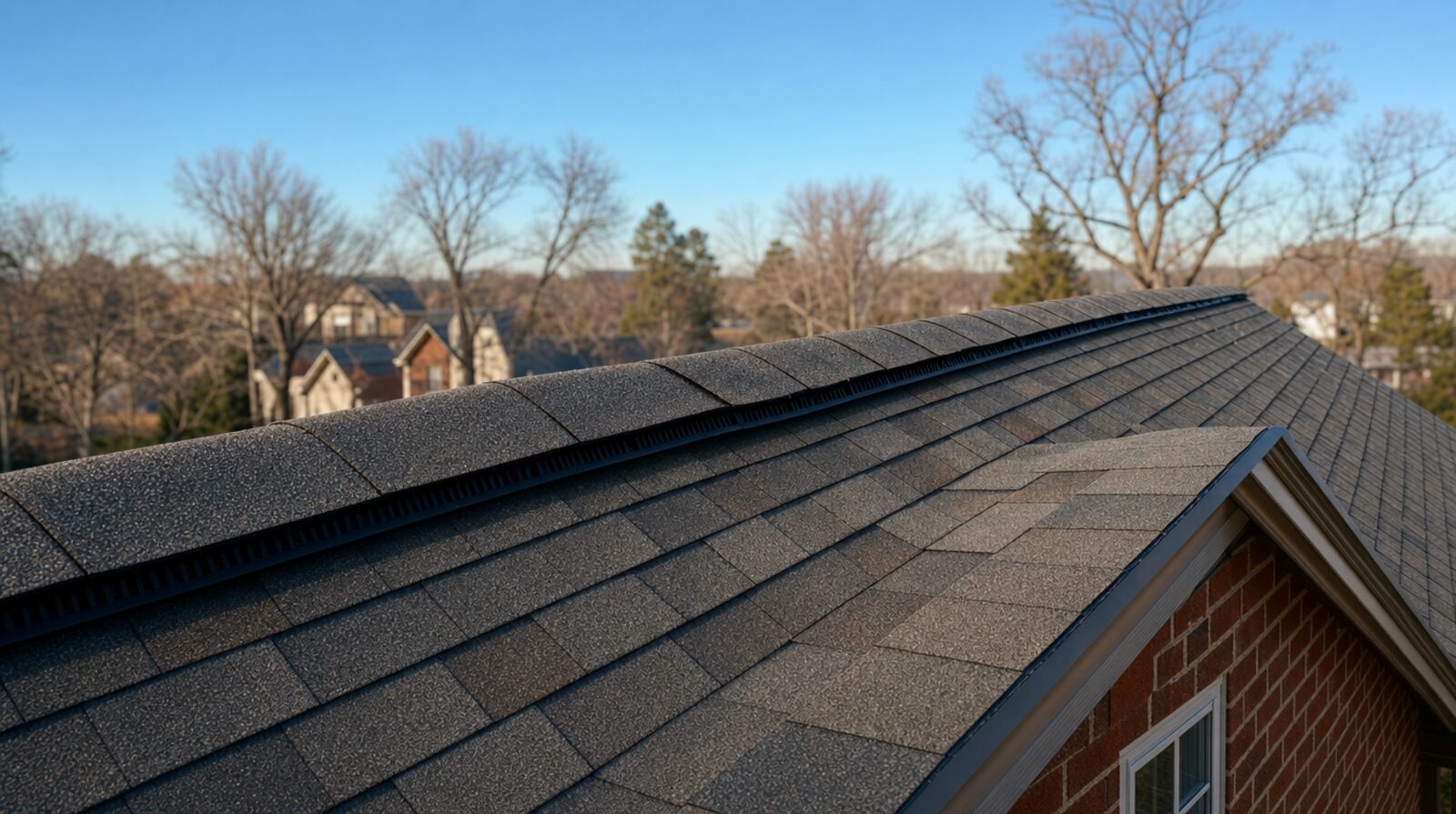
We get this question constantly on attic inspections around Greensboro, High Point, and Winston-Salem: "Do I really need to change my vents, or can we just patch what's up there?" It's a fair question, and the honest answer depends on what's currently on the roof and how the attic is behaving. But if you're re-roofing or building new, the ridge vent versus box vent decision is one worth understanding before your crew shows up, not after.
Why Attic Ventilation Matters More Than People Think
An attic is supposed to breathe. Cool, dry air comes in low — usually through soffit vents under the eaves — and hot, moist air exits high, near the ridge. That constant exchange does two jobs: it keeps summer attic temperatures from cooking your shingles from underneath, and it keeps winter moisture from condensing on the roof deck and framing.
Get the balance wrong and you'll see it eventually. Shingles curl and granulate early from trapped heat. Plywood decking delaminates or sags from moisture. In the worst cases we've opened up attics with black mold streaking across the rafters because warm, humid household air had nowhere to go. None of that is cheap to fix, and most of it traces back to a ventilation system that was undersized, blocked, or mismatched from the start.
Ridge Vents: The Modern Standard for Good Reason
A ridge vent is a continuous exhaust vent that runs along the peak of the roof, hidden under a cap shingle so it's barely visible from the ground. It works with the wind rather than against it — as air moves across the ridge, it creates negative pressure that pulls hot attic air out along the entire length of the roof, not just at one or two spots.
- Even coverage. Because the vent runs the full ridge line, there are no hot pockets sitting between vents the way you can get with spaced box vents.
- Passive operation. No moving parts, no electricity, nothing to burn out. It works whether there's a breeze or not, using the stack effect (hot air rising) as a backup to wind-driven flow.
- Clean roofline. Homeowners who care about curb appeal like that a ridge vent disappears under the cap shingles instead of poking up as visible boxes.
- Pairs correctly with soffit intake. Ridge vents are designed to work as a system with continuous or evenly spaced soffit vents. Without adequate low intake, even a well-installed ridge vent will underperform or, worse, pull conditioned air from the living space instead of the soffits.
The catch is that ridge vents only work on roofs with enough ridge length and the right geometry. A roof with lots of hips and short ridge runs, or a complicated roofline with multiple small sections, may not have enough net free area at the peak to exhaust the attic properly. That's when box vents earn their keep.
Box Vents: Still the Right Call in Certain Situations
Box vents (also called louvers or turtle vents) are individual static vents installed near the ridge, spaced out across the roof plane. They're older technology, but "older" doesn't mean "wrong" — it means situational.
- Short or broken ridge lines. Hip roofs, roofs with dormers, or additions with awkward rooflines sometimes don't have enough continuous ridge to install an effective ridge vent. Box vents let you place exhaust wherever the attic actually needs it.
- Retrofit simplicity. If a homeowner isn't replacing the whole roof and just needs better attic airflow, adding a couple of box vents is far less invasive than cutting a ridge slot.
- Budget-conscious projects. Box vents are inexpensive per unit, though you typically need several to match the exhaust capacity of one continuous ridge vent.
The downside: box vents create localized exhaust points, so attic air near the vents gets pulled out efficiently while air in between can stagnate. On a large or oddly shaped attic, that unevenness is where we start finding uneven shingle wear when we go back for inspections years later.
What We Actually Recommend for Triad Homes
Piedmont Triad summers are hot and humid enough that attic temperatures can climb well past what the outside air is doing, and our winters bring enough cold snaps that moisture condensation is a real concern too. That combination is exactly what continuous ridge ventilation was designed to handle, which is why it's our default recommendation on any roof with a straightforward, continuous ridge line and adequate soffit intake.
A few practical rules we follow on every ventilation job:
- Balance intake and exhaust. Roughly half your net free ventilation area should be at the soffits (intake) and half at the ridge or upper roof (exhaust). Exhaust without matching intake starves the system.
- Never mix exhaust types on one attic space. Running a ridge vent and powered gable fans on the same connected attic can short-circuit airflow, with the fan pulling air backward through the ridge vent instead of from the soffits.
- Check for blocked soffits before blaming the vents. We frequently find insulation stuffed into the eaves, choking off intake air entirely. A brand-new ridge vent installed over blocked soffits won't perform the way it should.
- Match the vent to the roof geometry, not the trend. A complex hip roof with short ridges may genuinely perform better with well-placed box vents than a token ridge vent that doesn't have enough length to move real air volume.
If you're not sure what's currently venting your attic, walk your yard on a sunny afternoon and look at the roofline from a distance — continuous vents at the peak are ridge vents, individual raised boxes are box vents, and round spinning units are turbines. Knowing what you have is the first step to knowing what you need.
Whichever system fits your roof, the goal is the same: an attic that stays close to outdoor temperature and humidity year-round, which protects your shingles, your decking, and your energy bills all at once.
Stop Guessing on Price
Get precise measurements and a detailed price range for your specific roof right now using our AI technology. No home visit required.
Get my price