 Back to Guides
Holiday Lights and Your Roof: How to Decorate Without Causing Damage


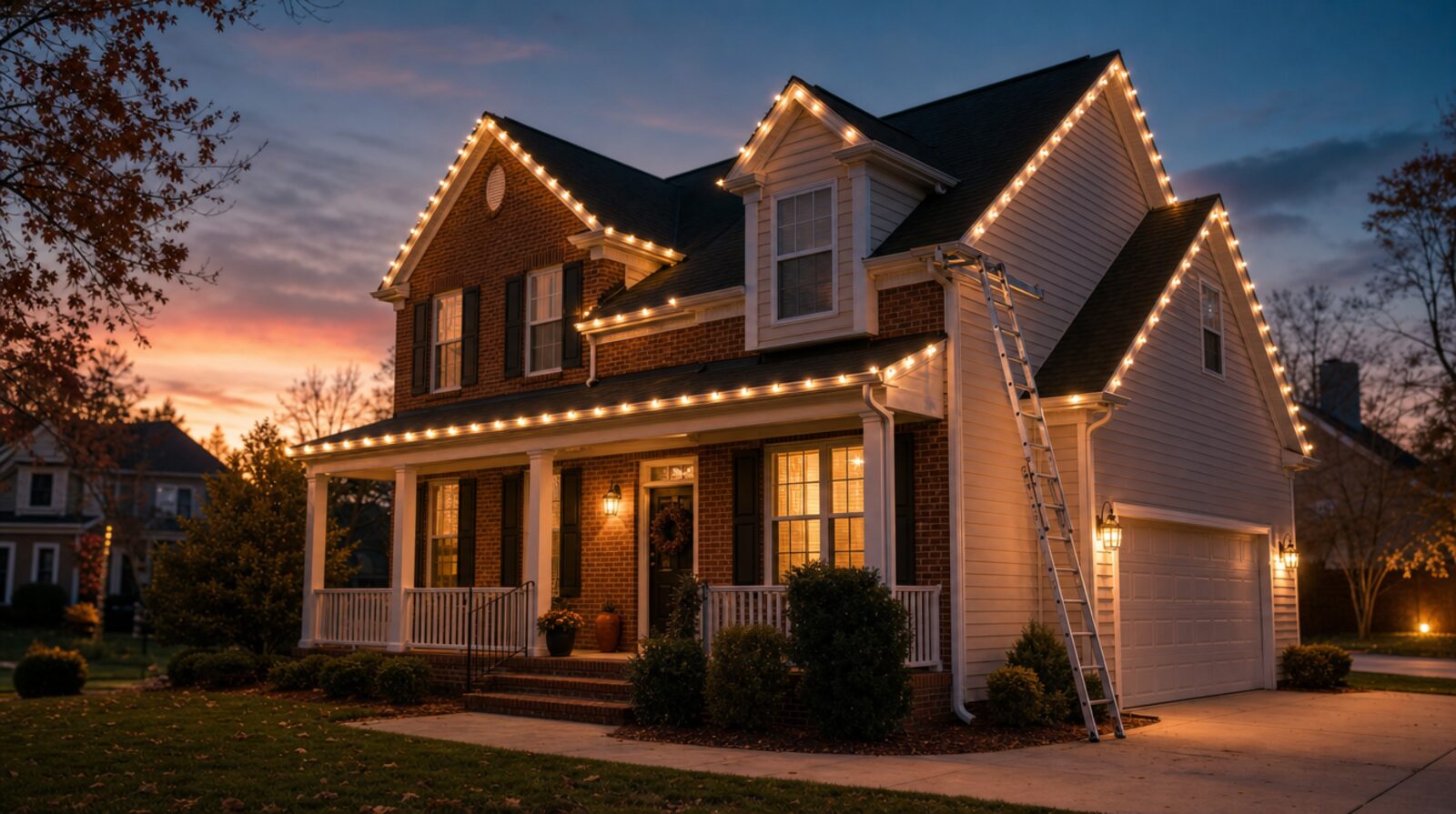
Every December we get the same call in January: "The roof was fine until we put the lights up." Holiday lighting doesn't have to cost you a repair bill, but we see the same handful of mistakes on Triad roofs every single season. Staples through shingles, ladders leaned straight onto gutters, extension cords pinched under ridge caps — none of it is necessary, and all of it is preventable if you know where the roof can take a fastener and where it can't.
Here's what our crews would tell you if we were standing on your driveway with a box of lights in your hands.
Where You Can (and Can't) Attach Lights Safely
The single biggest cause of winter roof leaks we trace back to holiday decorating is fasteners driven through the shingle field — the flat, open expanse of shingles rather than the edges. A staple or nail through the middle of a shingle punctures the waterproof layer underneath, and on a sloped roof that hole sits directly in the path of every rain that runs down toward your gutters. It may not leak in December. It often shows up as a stain on the ceiling in March, once freeze-thaw cycles have worked the hole open.
- Use gutter clips or shingle tab clips, not staples or nails. Plastic clips designed for C9 bulbs or mini-lights hook under the lip of the gutter or slide under the edge of a shingle tab without puncturing anything. They cost a few dollars more per box and they're worth every penny.
- Attach to the fascia board or gutter edge, never the shingle surface. The fascia (the trim board behind the gutter) can take a light-duty hook without compromising your roof system.
- Avoid the ridge and hips entirely. These are the highest-stress, most leak-prone areas of any roof. If you want a lit ridgeline, run a freestanding rope light along the ridge vent cap using clips made for that purpose — never fasteners driven into the ridge cap shingles themselves.
- Skip the staple gun altogether. We know it's the fastest tool for the job, but a staple gun doesn't let you control depth, and an over-driven staple tears the shingle mat instead of just pinning the wire.
Ladder Safety on Steep or Wet Piedmont Roofs
Roof falls spike every holiday season, and it's rarely because someone did something reckless — it's because a ladder was set up in a hurry on a cold, damp morning. December mornings in Greensboro, High Point, and Winston-Salem regularly start below freezing with dew or frost still on the grass and gutters, which makes both the ladder base and the roof edge more slippery than they look.
- Never lean a ladder directly on the gutter. Gutters aren't structural — they're thin aluminum or vinyl channels hung on brackets, and they'll bend, pull loose, or simply give way under a ladder's weight. Use a standoff stabilizer bar that spans the gutter and rests against the fascia or roof edge instead.
- Check the ground before you check the roof. Set ladder feet on firm, level, dry ground. On sloped yards (common in a lot of Triad neighborhoods), use ladder levelers rather than propping one foot on a paver or stack of wood.
- Follow the 4-to-1 rule. For every 4 feet of height to the point the ladder touches the house, the base should sit 1 foot away from the wall. A ladder set too upright is far more likely to kick out backward.
- Don't decorate a wet or frosted roof, period. If you need to physically step onto the roof surface to reach a peak or dormer, wait for a dry, above-freezing afternoon. Wet asphalt shingles have essentially no traction, and algae-shaded northern slopes stay slick long after the rest of the roof has dried.
- Work with a partner. Someone holding the ladder base and handing up light strands cuts your number of trips up and down dramatically — fewer trips means fewer chances for a slip.
Cords, Timers, and Keeping Water Out of Your Gutters
Beyond the roof surface itself, two other spots cause trouble every year: gutters packed with light cords and fallen leaves, and extension cords routed in ways that trap moisture against the house.
- Clean the gutters before you decorate, not after. Early December is usually past leaf-drop for most Triad hardwoods, so this is your last real window to clear gutters before ice season. Running lights over a gutter full of wet leaves just adds weight and blocks drainage right at the spot where your roof edge needs to shed water fastest.
- Route cords so water runs away from window and door seals, not into them. A cord draped across a windowsill or tucked into a door frame can wick water into the framing during a driving rain — use the factory-drilled routing clips on your outlet covers instead.
- Use exterior-rated, GFCI-protected outlets only, and keep any plug connections up off the ground on a small stand or hook so they're not sitting in a puddle after the next front comes through.
- Put lights on a timer. It's not a roof-safety tip so much as a "don't leave connections energized and unattended for six weeks straight" tip — but it matters, especially if a connector gets rained on.
Taking Lights Down Without Undoing Your Work
The teardown in January causes almost as much damage as the install, mostly because people are in a hurry to get it over with. Pulling clips off too fast can crack cold, brittle shingle tabs — asphalt shingles get noticeably stiffer and more fragile in cold weather. Take the same care removing lights that you did hanging them: unclip rather than yank, coil cords instead of pulling them free of the house in one motion, and do a quick visual check of your shingles, flashing, and gutters while you're up there. If anything looks lifted, cracked, or loose, that's worth a call before it turns into a spring leak.
A few extra minutes of care with clips instead of staples, and a stabilizer bar instead of a bare ladder against the gutter, is the difference between a roof that looks great through New Year's and one that needs a repair call once the lights come down.
Stop Guessing on Price
Get precise measurements and a detailed price range for your specific roof right now using our AI technology. No home visit required.
Get my price